From Crawling to Cruising: How Surestep’s SMO3D Supported Olivia’s Journey
When Olivia was diagnosed with severe global developmental delay and hypotonia at 15 months, her family feared she might never walk or keep up with her siblings. Born at 33 weeks, Olivia’s early delays had kept her parents watchful from the start. At first, they chalked the slower pace up to her premature arrival. But by 15 months, something felt different. Her family sensed that Olivia was falling further behind than her adjusted age could explain, and they trusted that feeling.
A neurology referral provided an answer: severe global developmental delay and hypotonia. Through genetic testing, they also discovered a variance of unknown significance in the SRRM2 gene. For Olivia and her family, this answer was the start to helping Olivia reach her milestones.
Building a Foundation
Olivia made progress in therapy, but movement remained a significant challenge. She was not yet cruising furniture or climbing. Crawling had become her comfort zone, and her mother, Anna, worried that walking might stay out of reach.
“She was getting so comfortable crawling,” Anna says. “I worried she would never get to practice walking.”
Olivia’s parents noted that one foot was more pronated than the other, with pronation being a common finding in children with low muscle tone. In combination with her gross motor delays including not walking yet, her healthcare team suggested ankle braces – specifically SMOs.
SMO stands for Supramalleolar Orthosis—a type of lightweight ankle brace that sits just above the ankle bones (the “malleoli”) and fits inside a shoe.
What Do SMOs Do?
SMOs help improve foot and ankle alignment. They provide gentle support to keep the heel and foot in a more stable and optimal position during standing and walking. Unlike taller braces, SMOs allow for more natural ankle movement while still offering targeted stability. This helps children build strength and coordination while moving more confidently and safely.
The decision to move forward with SMOs was one Anna approached with cautious optimism and a few understandable nerves. Would Olivia tolerate wearing them? Would the daily routine of getting them on and off become a source of stress for the whole family? These are questions many parents quietly carry into their first orthotics appointment.
“I was a little nervous and intimidated wondering if she was going to like them and about even the process of getting them on and off,” Anna says.
A Turning Point
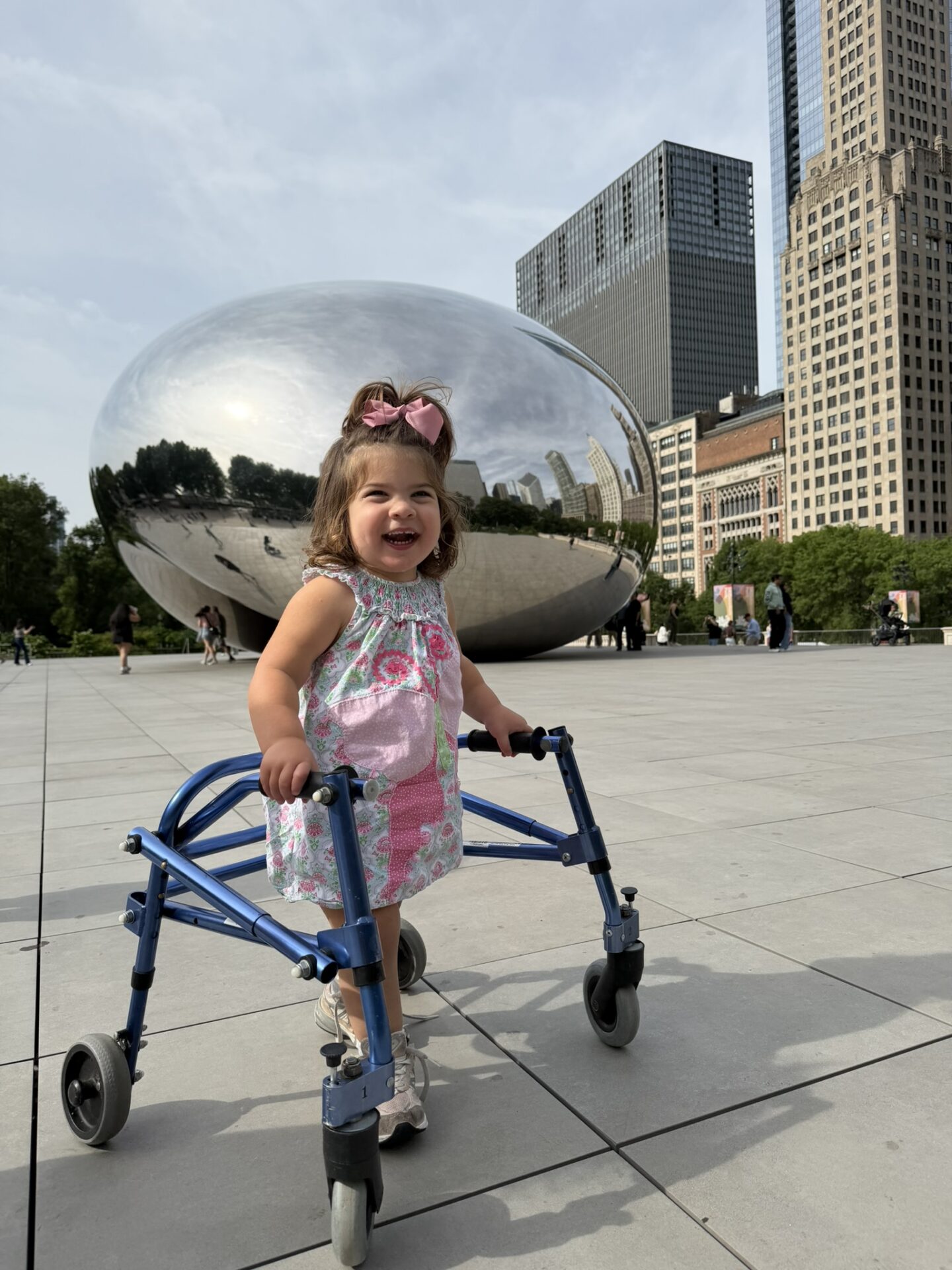
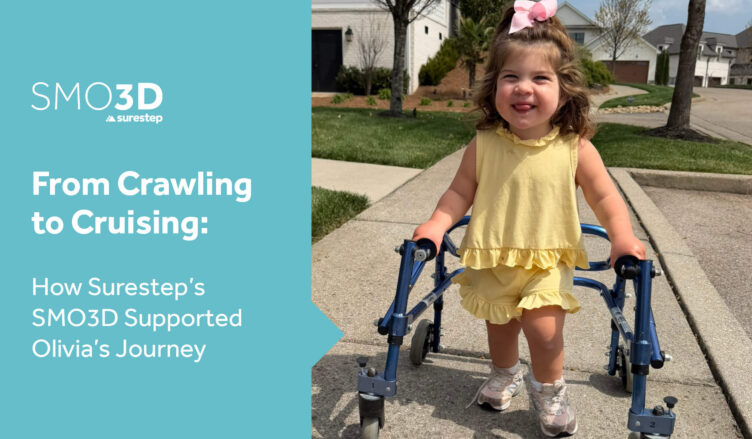
Olivia started out with Surestep SMOs on both sides to provide her with dynamic movement, paired with a reverse walker that helped her stay upright while she practiced standing. These braces supported her feet and ankles while the walker took some of the work off her body as she built strength. It worked beautifully. Soon Olivia was pulling herself up on her own, figuring out how to steer the walker, and seeking out standing on her own. She kept building her balance and getting more comfortable staying upright.
As Olivia got bigger and stronger, she started working towards more advanced skills. She presented with gait asymmetry as the one leg rotated out more than the other. With goals of continued symmetry, energy efficiency, and play, her team suggested switching to the 3D printed Surestep SMO3D to keep her moving forward. This new brace gave her exactly what she needed at this stage: continued dynamic support that lets her keep exploring new movements without holding her back, a breathable design so she doesn’t overheat when she’s working hard, flexible structures over her malleoli for increased comfort, and bonus for parents: a narrower heel post that’s way easier to slip into shoes.
As Olivia spent more time upright and on the move, her strength improved. The asymmetry Anna had noticed in her gait began to resolve. With the SMOs, her body learned to work in a more supported, aligned position. Motor milestones that had once seemed distant started arriving, one after another. And at 27 months, Olivia has even taken a few steps on her own.
She Loves Being Vertical
The shift in mobility has had an impact that extends beyond the physical. When a child can move through the world more freely, engage with siblings, explore her environment, and participate in play in new ways, development has more room to happen across the board.
“It’s so fun to see Olivia chase her older siblings around and interact with them in ways she wasn’t able to before,” Anna says. “In addition to motor development, I feel her progress has helped with her other areas of development as well.”

For Parents Still on the Fence
Anna understands the hesitation. She felt it herself. The unknown of a new device, the worry about whether your child will accept it, the logistics of making it part of an already full daily routine. But looking at where Olivia is now compared to where she started, her perspective is clear.
“It’s a no brainer,” Anna says. “We want to give our kids the tools to help them succeed and live as normal a life as possible. SMOs are one of those tools.”
Explore Surestep
Every child’s journey looks different, but no parent should have to navigate it without the right tools. If you have questions about whether SMOs could support your child’s development, start the conversation with your pediatric orthotist or physical therapist. And if you are ready to find a Surestep provider, we are here to help you get there.