Evidence-Based Case of SMO3D-Supported Motor Development in Severe Global Developmental Delay
Olivia’s Story
Olivia presented at 15 months corrected age with a diagnosis of severe global developmental delay and hypotonia, following a genetic finding of a variant of unknown significance in the SRRM2 gene. Born at 33 weeks, Olivia demonstrated delayed milestones consistent with her prematurity through the first year. However, by 15 months, her developmental trajectory suggested delays beyond those that could be explained by prematurity alone. A neurology referral confirmed severe global developmental delay and hypotonia as the underlying diagnosis.
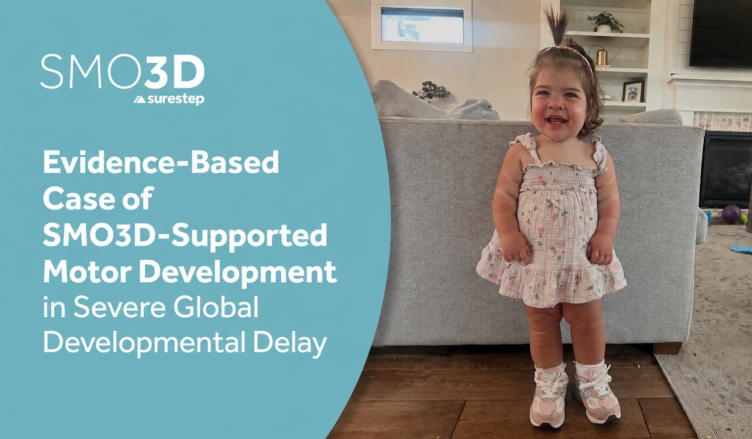
At the time of orthotics evaluation, Olivia demonstrated significant motor limitations. She had not yet achieved independent standing, cruising, or climbing. Crawling was her primary mode of mobility, and she was demonstrating reluctance to practice standing or weight-bearing activities. While in assisted weight bearing, Olivia presented with excessive pronation, a common secondary finding in children with low muscle tone and altered motor control, with more pronation on right relative to left. She also presented with a wide base of support and external rotation of lower extremities with the right side more than left.
Clinical Presentation
From a movement perspective, Olivia’s hypotonia created a biomechanical challenge. With increased hypermobility, she lacked stability at her core and extremities, resulting in inefficient alignment and compensatory movements. Lack of typical movements can reduce proprioceptive input needed for motor planning. More critically, the lack of vertical weight-bearing practice meant she was not building the antigravity strength necessary for progression to standing and walking.
Olivia’s presentation fit the profile for dynamic SMO intervention. An earlier white paper by Smith, former director at Surestep, examining 18 children with developmental delay, benign hypotonia, and significant pronation, found that children wearing Surestep SMOs demonstrated dramatic acceleration in gross motor skill acquisition. Prior to orthotic intervention, children in the pulling-to-stand/cruising phase (similar to Olivia’s baseline) were acquiring skills one to four times slower than typical developmental rates. Following Surestep SMO fitting, this same group started to acquire gross motor skills more quickly than pre-intervention and worked towards catching up to their peers.
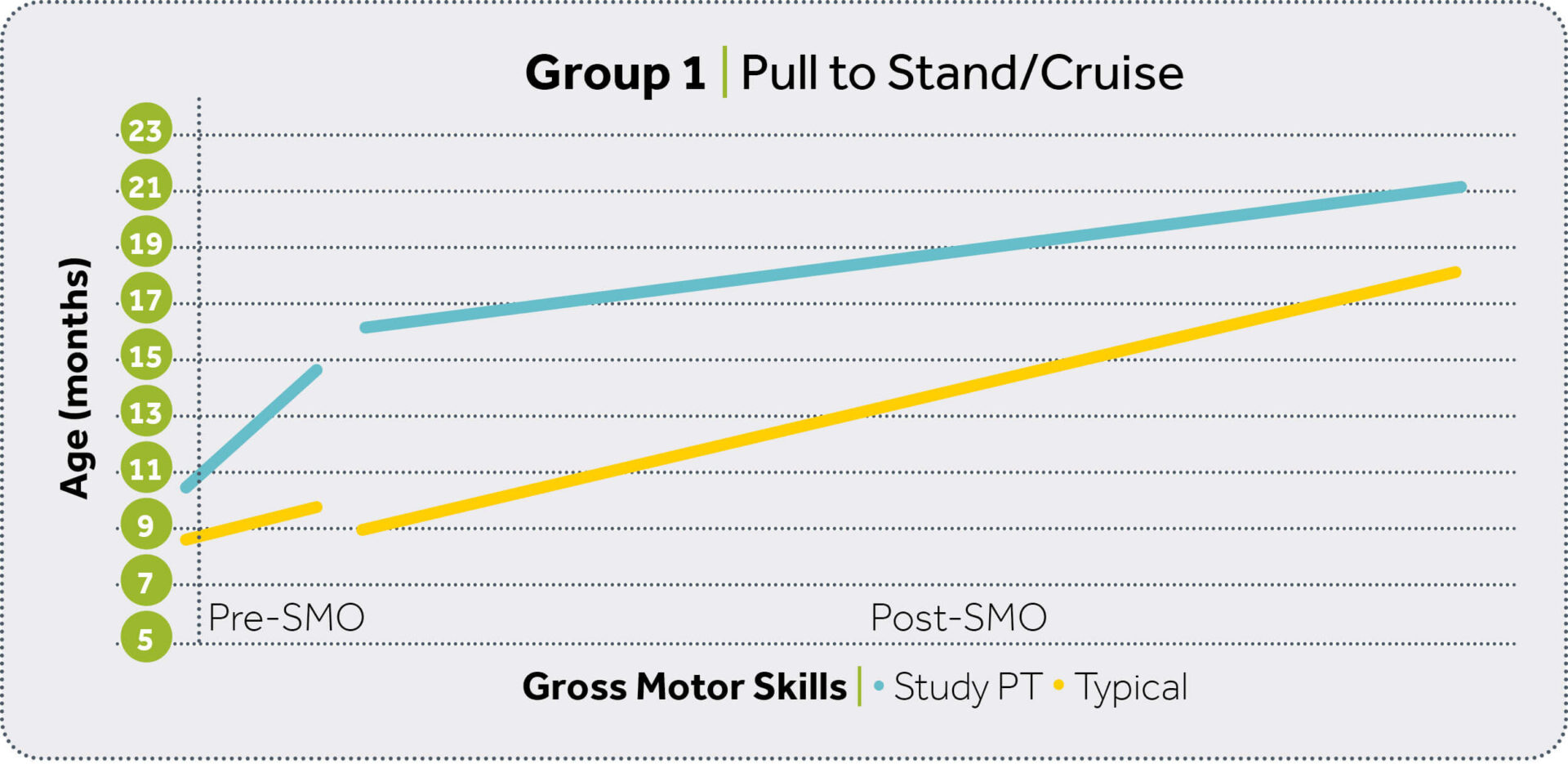
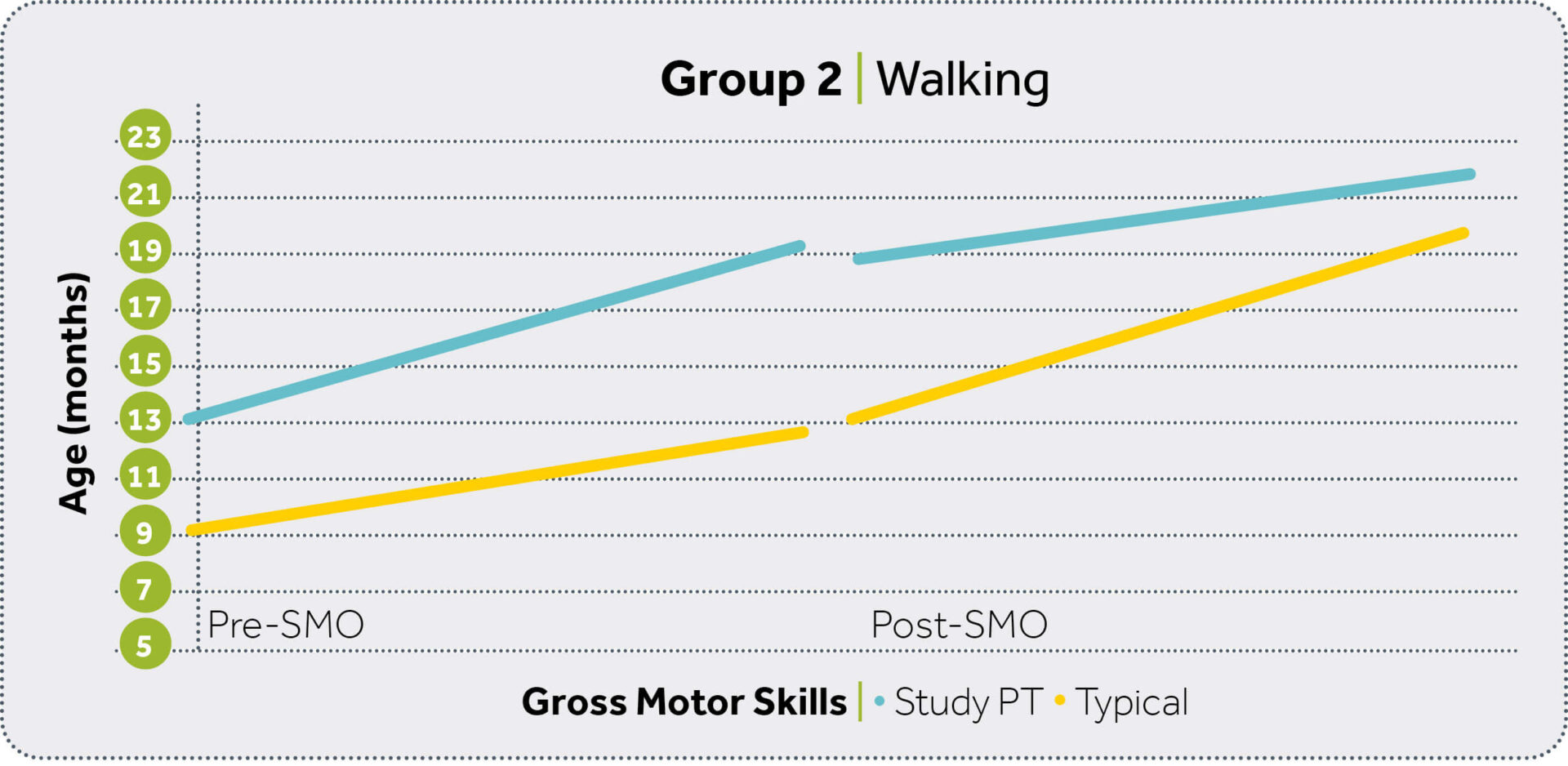
Comparison of the rates of gross motor skill gains of study participants to typical developing children pre and post receiving SMOs for both Group 1 (Pulling to Stand/Cruising) and Group 2 (Walking).
Many children with severe hypotonia will avoid standing if it requires excessive energy expenditure or feels unstable. This avoidance creates a cycle: without practice, strength does not develop; without strength, motivation to practice decreases. Olivia needed a tool that would reduce the biomechanical demand of standing so she could practice weight-bearing without fatigue or instability limiting her trial repetitions.
SMO3D with Postural Support Strategy
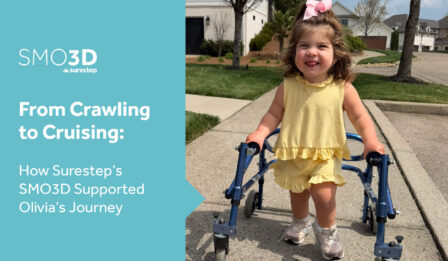
Olivia was initially fitted with bilateral standard Surestep SMOs paired with a reverse walker to create a graduated support strategy. The orthoses addressed her foot and ankle biomechanics while the walker provided antigravity support for the trunk and lower extremities during standing practice. With the standard SMOs in place, Olivia made significant progress. She developed the ability to pull herself upright independently, began steering the walker, and sought out vertical postures on her own. She continued working on standing balance, weight-shifting, and tolerance for sustained upright practice.
As Olivia grew and her motor skills advanced, she outgrew her initial orthoses. The clinical team recommended transitioning to the Surestep SMO3D to continue supporting her progression toward independent walking. The SMO3D, with the same dynamic, clinical approach as her initial standard Surestep SMO, offered several additional advantages aligned with her advancing needs: flexible structure over ankle bones for increased comfort, a narrower heel post to facilitate easier donning and doffing, and a perforated design to improve heat dissipation during increased activity.
By continuing to provide dynamic support and increased proprioception through compression, Olivia adapted to the SMO3D well and was able to continue to make progress toward her milestones. Over time with improved coordination and motor control, she has greater confidence being upright while the SMO3D continues to provide the segmental stability necessary for normal gait mechanics and peer participation.
Clinical Outcomes
The outcomes in Olivia’s case demonstrate the expected cascade when dynamic biomechanical support enables motor practice in a child with hypotonia.
As she started ambulating with the posterior walker more and transitioned to the SMO3D, several things happened simultaneously:
The asymmetry in her gait began to resolve. The pronation, which had been asymmetrically greater on the right foot, began to normalize as her body learned to work in a supported, aligned position. This mirrors findings in the Smith white paper, in which children with secondary gait asymmetries showed normalization after SMO fitting, suggesting the asymmetry was a motor-control problem responsive to postural support and practice, not a fixed structural issue.
Her standing tolerance increased. “She loves being vertical now,” her mother reports, indicating that standing shifted from being an effortful, avoided activity to something she sought out and enjoyed. This shift in motivation directly enabled the repetitive practice necessary for skill development.
At 27 months, Olivia has taken her first independent steps. More importantly, she is now engaging in play with her siblings in ways she was unable to before. She is chasing, exploring her environment, and participating in functional activities that naturally drive motor learning across multiple domains.
For Practitioners
When evaluating a young child with hypotonia who is avoiding or unable to sustain weight-bearing activity, consider whether external support might unlock the motor practice necessary for progression. The evidence is clear: children fitted with SMOs do not slow down developmentally; they accelerate. Olivia’s case is not exceptional. It is representative of what should be expected when we provide the right tool at the right time.
The SMO3D, combined with appropriate postural support tools, creates an environment where a child can sustainably practice being vertical. Over time, as the child’s strength increases, the demand on the device decreases naturally. This is orthotic management working as intended: scaffolding motor development, not replacing it.