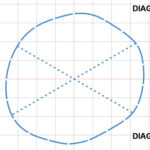
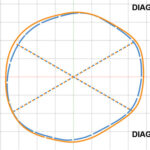
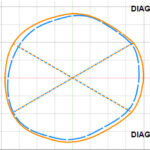
When Milo’s mom, Olivia, first raised concerns about her 7-month-old’s head shape, his pediatrician referred her to a local orthotist for a cranial remolding orthosis. After hearing about traditional and 3D printed options, Olivia felt confident in choosing Surestep’s new Sprout3DTM helmet due to its lightweight structure, single-sided hinge opening (making it easier for busy parents to open with only one hand), the perforated foam for better ventilation, and a plagiocephaly-specific trim line.
Summary
After being measured by his clinician, Milo’s helmet was fabricated with top-of-the-line 3D printing technology, allowing for a quick turnaround time and a precise fit – resulting in minimal modifications.
Milo’s helmet journey was a breeze for both Milo and mom, with Olivia saying, “When I took my son to his pediatrician, she couldn’t believe how easy it was to take the helmet on and off. The unique snap-on feature was probably the most raved about in my circle of friends and family.”
Throughout the helmet journey, Milo went through a couple growth spurts and received quick adjustments with minimal modifications – providing ease and comfort for both Milo and mom. Thanks to Sprout3D’s breathable features, Milo stayed cool despite his hot nature, and Olivia was able to easily clean the helmet.
Results
With his measurements moving from moderate severity to the normal range, Milo successfully “graduated” with flying colors after only two short months! Olivia states, “I would recommend Sprout3D to anyone who is considering a helmet for their child. I truly could not have asked for a better experience for my son.”
The patient was born full term. She was 6 pounds 12 ounces and 19 ½ inches long. She left the hospital with mom two days after delivery. Prenatal history included nicotine use. An MRI had findings of periventricular leukomalacia. She had a negative genetic workup. Additional diagnoses included dystonia, esotropia, strabismus, dysphasia and reflux. She was placed on baclofen at age 1 year.
She started physical therapy at 14 months. She received aquatic therapy, physical therapy and vision therapy at home. During that time, no major gross motor skill gains were made and other interventions were considered. She was unable to roll or sit and had significant head lag with pull to sit and poor head control in any position. Her eyes were closed in any upright position. In side-lying, with her head supported, she would open her eyes and track objects.
At this time, it was determined that she needed head support in sitting to work on endurance and visual spatial, cognitive and social skills in a seated position. A Surestep Dynamic Cervical Orthosis (DCO) was used to facilitate external head support and control. The DCO was a good fit for her size and for the fact that it did not require an external chair for use.
Method
She utilized the DCO in her home daily for four weeks. Wear time ranged between 20 and 45 minutes per session. Her caregiver reported that during these sessions, she also worked on focused attention and play. This should be taken into consideration when looking at her fatigue levels.
Results
Prior To Use
After 2 Weeks of Use
After 4 weeks of Use
Range of Motion
Pectoral muscle protracted bilaterally.
Range increased to neutral, easier passive range of motion into protraction.
Sitting
Would sit with bilateral upper extremity pedi wraps donned and placed in sitting position with tactile cures at upper lip for motivation to lift into midline. She could hold position with constant tactile cues for ten seconds prior to loss of balance or head falling into flexion.
She would sit with bilateral upper extremity pedi wraps donned and placed in sitting positon with maximum assistance at mid-trunk. With DCO and pedi wraps, she would bring her head up independently and hold for 10 seconds.
She would prop sit independently when placed for 5 seconds.
Eyes/Head Control
Would open eyes majority of the time when in side-lying or with head supported. She would hold her head in midline for 2 seconds.
Would keep eyes open in supported sitting with improved tracking. She would hold her head in midline for 5 seconds.
Gross Motor
Would roll side to side but not completely into side-lying.
Would roll from supine to side-lying and almost into prone but is unable to clear arm to complete skill.
Endurance
Would tolerate up to 20 minutes with DCO on in focused play.
Would tolerate 30-45 minutes with DCO on in focused play.
The Surestep TLSO is a flexible, dynamic solution that works through compression to support the trunk. Circumferential compression helps maintain and regulate intracavitary pressures to improve posture, sensory input, motor skills, gait, speech, and breathing.
How is it different?
Many other TLSOs either only provide compression (garments) or are made of thicker, more rigid plastic.
What are the indications?
The Surestep TLSO is ideal for patients with:
Hypotonia or hypertonia
Poor trunk/posture control
Neuromuscular scoliosis
It can be worn in a stander or seating system. It can also be combined with the Dynamic Cervical Orthosis (DCO) for those patient with poor head control.
It is appropriate for individuals across the gross motor skill spectrum:
Sitting: Use the TLSO to free hands to play with toys, work on feeding, speech, and breathing.
Walking: Use the TLSO to improve posture, symmetry, arm swing, energy expenditure, speech, and breathing.
What modifications are available?
The Surestep TLSO is custom fabricated with several avilable modifications:
Openings of the TLSO can either be:
Anterior
Posterior (ideally paired with the abdominal cutout and/or anterior gill modification)
Breathing modifications include:
Abdominal Cutout (with or without a Gusset) allow for diaphragmatic breathing. The gusset helps maintain compression on the abdomen. This cutout typically encompasses a g-tube, which allows for easier access.
Lateral Gill Modification allows lower rib lateral movement. This allows the ribs and lungs to expand for increased air intake.
Anterior Gill Modifications allows for anterior/superior chest translation during breathing.
Accommodations can also be made for Baclophen pumps and G-tubes.
Breathing and Postural Control are Connected
It's important to take breathing into account whenever providing a TLSO. Patterns of breathing include diaphragmatic, lower lateral rib flare, and anterior/superior upper chest rise. It is common for patients with postural deficits and/or neuromuscular scoliosis to also have breathing deficits. Some patients may be primarily belly breathers, while others may be primarily upper chest breathers.
Modifications on TLSOs not only allow a patient to breathe in their primary pattern but can also help enhance the breathing and/or postural work during therapy.
The Open Heel Modification is a modification available on most of Surestep’s lower extremity products. Instead of the standard heel post, the plastic is cut away on the plantar surface of the heel. To reduce the risk of pinching and to maintain compression and calcaneal position, we have added a very thin molded inner boot.
Who is it for?
Children with low or high muscle tone (regardless of underlying diagnosis) who have anterior weight lines, sensory deficits and/or a fast transition from initial contact to footflat (including knee extension moment).
Does it still control the calcaneus, or pronation like the standard version?
Yes! We have compared Standard Surestep SMOs to Surestep SMOs with the open heel modification. There were no significant differences in the calcaneal position – both styles of SMOs controlled pronation. Because of Surestep’s unique plastic and utilization of compression, an SMO with the open heel modification can still correct excessive pronation.
Doesn’t it make the SMO bulkier?
Overall, no. Even though there is an extra layer of material, because it works through compression, the SMOs are nearly identical. We took a series of measurements of both a standard Surestep SMO with a heel post and a Surestep SMO with an open heel. Here’s what we found: At the metatarsals, or ball of the foot, the SMO with open heel was 1/16” wider. There was no difference in width at the malleoli (ankle bones) or in overall foot length. At the instep (measuring diagonal around the heel), the SMO with open heel was ¼” smaller.
Is it harder to get into shoes?
Slightly. There is a trick, though. Do not “push” the heel of the shoe on. Rather, use a big twisting motion to get started and over the “lip” of the plastic. Then, you should be able to push it on the rest of the way.
Does it actually make a difference?
Yes! We are seeing fantastic functional changes in our kiddos wearing Surestep SMOs, Toe Walking SMOs and AFOs with the open heel modification. Kids are now able to shift their weight more posteriorly, can squat more appropriately and are developing heel-toe gait patterns with more extension. We are slowing down the transition from initial contact to footflat, which also helps with posterior balance reactions and improved gait. We have also heard great feedback about the increased sensory input to the heel. Download PDF for examples.
What products does it apply to?
You can ask for the open heel modification on our SMOs, Toe Walking SMOs, Pullover AFOs, Advanced AFOs and Hinged AFOs. You can also ask for it on the SMO portion of any 2-Stage AFO.
Can it be applied to any level of support or control?
No, an Open Heel modification can only be applied to products that provide dynamic stability.
By subscribing I acknowledge that I would like to receive emails from ACP, which may include marketing communications regarding ACP products, services, and events. I can unsubscribe at any time.
ACP values your privacy. To learn more, visit our Privacy Statement.