SMO3D: Which Model is Right for Your Patient?
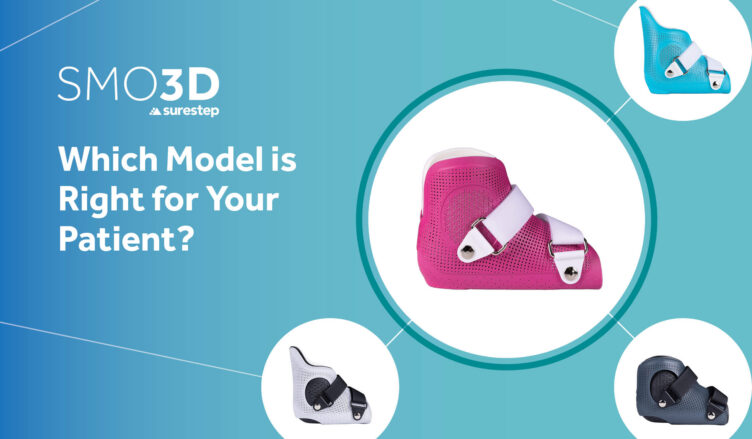
Surestep’s SMO3D family now includes three models, each designed for distinct patient needs. Which model is right for your patient? This quick guide is designed to help you decide.
SMO3D Standard
The standard SMO3D is a flexible, 3D-printed device with a dynamic stability support level. It can be fabricated from measurements, a cast, or a scan, and printed from PA 12 nylon.
It’s a strong fit for children with:
- Excessive pronation
- Triplanar instability in weight-bearing
- Developmental delays in standing, walking, or gait development
- Mild toe walking
- Poor coordination or balance
- Lack of proprioception
It’s less suited for children who need more control than an SMO provides, have a very bony foot, require plastic modifications to control adduction rather than abduction, or have moderate toe walking. For moderate toe walking, consider the Toe Walking SMO3D.
For more on how the SMO3D compares to Surestep’s thermoplastic SMO, check out this blog post.
SMO3D Toe Walking
The Toe Walking SMO3D is designed for children with mild to moderate toe walking, particularly when sensory or stability concerns are present. Its extended posterior tongue gives kids a consistent physical cue for heel contact while still supporting natural movement requiring some plantarflexion.
It’s a strong fit for children who:
- Spend more than half their time on their toes
- Show excessive pronation
- Have anterior weight lines without lateral weight shifts
It’s less suited for children who need an AFO due to postural control deficits, a full footplate, or can’t reach 90 degrees of foot dorsiflexion with knees extended.
SMO3D Open Heel
The Open Heel SMO3D is built for children with:
- Anterior weight lines
- Sensory deficits
- Quick transitions from initial contact to footflat
- Mild toe walking due to sensory deficits
- Weak dorsiflexors
The plastic is cut away at the plantar heel, and a thin molded inner boot supports the foot. This allows for compression of the fat pad under the calcaneus, increasing sensory input at the heel and slowing down the transition between initial contact and footflat.
The TPU molded inner boot does add material, so it is less suited for children who prioritize a more low-profile option or who need more stability with an AFO.
SMO3D Toe Walking/Open Heel Combo
Have a patient who could benefit from both modifications? The SMO3D is also available in a Toe Walking/Open Heel combo. It combines increased sensory input at the heel with a kinesthetic reminder from the posterior tongue. This modification is great for kids with sensory deficits who toe walk 50-90% of the time
Ready to dive deeper? Our free, on-demand course, Printing Potential: Advancing Gross Motor Skills with the Surestep SMO3D (1.5 CEUs), offers an in-depth look at the SMO3D family.
For more guidance on which model may best suit your patient, contact our team at [email protected].