Tag: SMO3D

Evidence-Based Case of SMO3D-Supported Motor Development in Severe Global Developmental Delay

Evidence-Based Case of SMO3D-Supported Motor Development in Severe Global Developmental Delay

Olivia’s Story

Olivia presented at 15 months corrected age with a diagnosis of severe global developmental delay and hypotonia, following a genetic finding of a variant of unknown significance in the SRRM2 gene. Born at 33 weeks, Olivia demonstrated delayed milestones consistent with her prematurity through the first year. However, by 15 months, her developmental trajectory suggested delays beyond those that could be explained by prematurity alone. A neurology referral confirmed severe global developmental delay and hypotonia as the underlying diagnosis.

At the time of orthotics evaluation, Olivia demonstrated significant motor limitations. She had not yet achieved independent standing, cruising, or climbing. Crawling was her primary mode of mobility, and she was demonstrating reluctance to practice standing or weight-bearing activities. While in assisted weight bearing, Olivia presented with excessive pronation, a common secondary finding in children with low muscle tone and altered motor control, with more pronation on right relative to left. She also presented with a wide base of support and external rotation of lower extremities with the right side more than left.

Clinical Presentation

From a movement perspective, Olivia’s hypotonia created a biomechanical challenge. With increased hypermobility, she lacked stability at her core and extremities, resulting in inefficient alignment and compensatory movements. Lack of typical movements can reduce proprioceptive input needed for motor planning. More critically, the lack of vertical weight-bearing practice meant she was not building the antigravity strength necessary for progression to standing and walking.

Olivia’s presentation fit the profile for dynamic SMO intervention. An earlier white paper by Smith, former director at Surestep, examining 18 children with developmental delay, benign hypotonia, and significant pronation, found that children wearing Surestep SMOs demonstrated dramatic acceleration in gross motor skill acquisition. Prior to orthotic intervention, children in the pulling-to-stand/cruising phase (similar to Olivia’s baseline) were acquiring skills one to four times slower than typical developmental rates. Following Surestep SMO fitting, this same group started to acquire gross motor skills more quickly than pre-intervention and worked towards catching up to their peers.
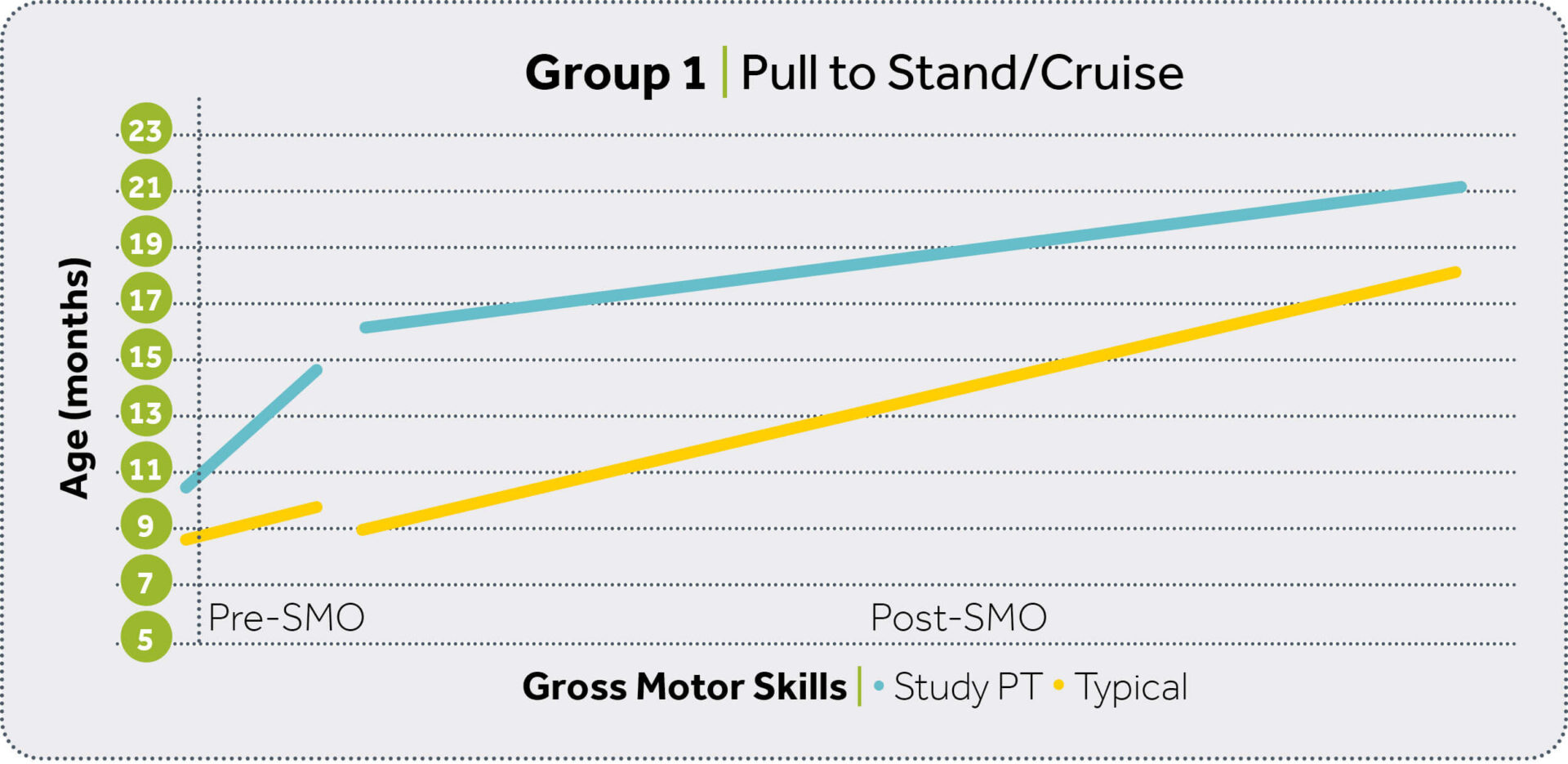
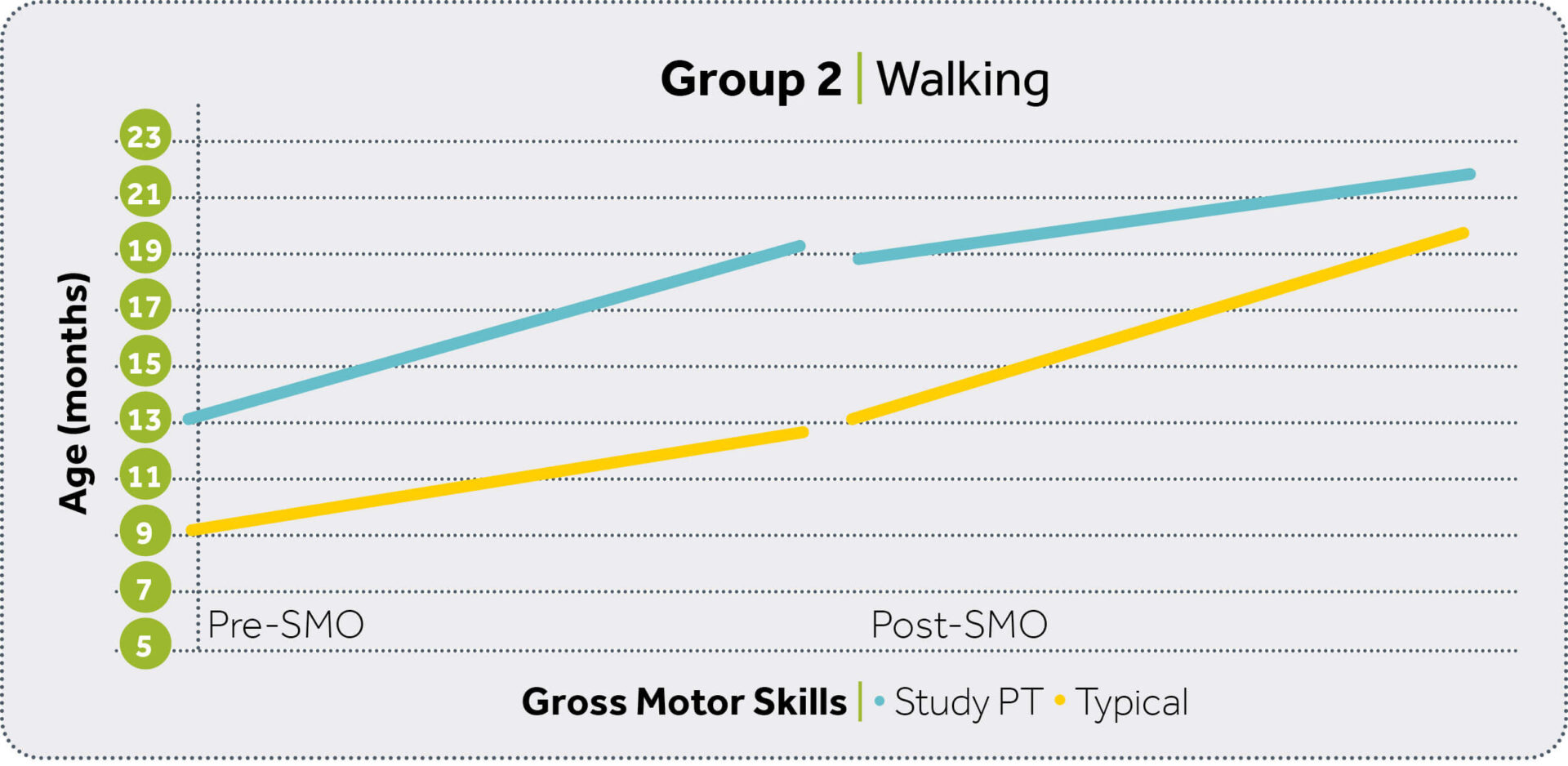
Comparison of the rates of gross motor skill gains of study participants to typical developing children pre and post receiving SMOs for both Group 1 (Pulling to Stand/Cruising) and Group 2 (Walking).

Many children with severe hypotonia will avoid standing if it requires excessive energy expenditure or feels unstable. This avoidance creates a cycle: without practice, strength does not develop; without strength, motivation to practice decreases. Olivia needed a tool that would reduce the biomechanical demand of standing so she could practice weight-bearing without fatigue or instability limiting her trial repetitions.

SMO3D with Postural Support Strategy

Olivia was initially fitted with bilateral standard Surestep SMOs paired with a reverse walker to create a graduated support strategy. The orthoses addressed her foot and ankle biomechanics while the walker provided antigravity support for the trunk and lower extremities during standing practice. With the standard SMOs in place, Olivia made significant progress. She developed the ability to pull herself upright independently, began steering the walker, and sought out vertical postures on her own. She continued working on standing balance, weight-shifting, and tolerance for sustained upright practice.

As Olivia grew and her motor skills advanced, she outgrew her initial orthoses. The clinical team recommended transitioning to the Surestep SMO3D to continue supporting her progression toward independent walking. The SMO3D, with the same dynamic, clinical approach as her initial standard Surestep SMO, offered several additional advantages aligned with her advancing needs: flexible structure over ankle bones for increased comfort, a narrower heel post to facilitate easier donning and doffing, and a perforated design to improve heat dissipation during increased activity.

By continuing to provide dynamic support and increased proprioception through compression, Olivia adapted to the SMO3D well and was able to continue to make progress toward her milestones. Over time with improved coordination and motor control, she has greater confidence being upright while the SMO3D continues to provide the segmental stability necessary for normal gait mechanics and peer participation.

Clinical Outcomes

The outcomes in Olivia’s case demonstrate the expected cascade when dynamic biomechanical support enables motor practice in a child with hypotonia.

As she started ambulating with the posterior walker more and transitioned to the SMO3D, several things happened simultaneously:

The asymmetry in her gait began to resolve. The pronation, which had been asymmetrically greater on the right foot, began to normalize as her body learned to work in a supported, aligned position. This mirrors findings in the Smith white paper, in which children with secondary gait asymmetries showed normalization after SMO fitting, suggesting the asymmetry was a motor-control problem responsive to postural support and practice, not a fixed structural issue.

Her standing tolerance increased. “She loves being vertical now,” her mother reports, indicating that standing shifted from being an effortful, avoided activity to something she sought out and enjoyed. This shift in motivation directly enabled the repetitive practice necessary for skill development.

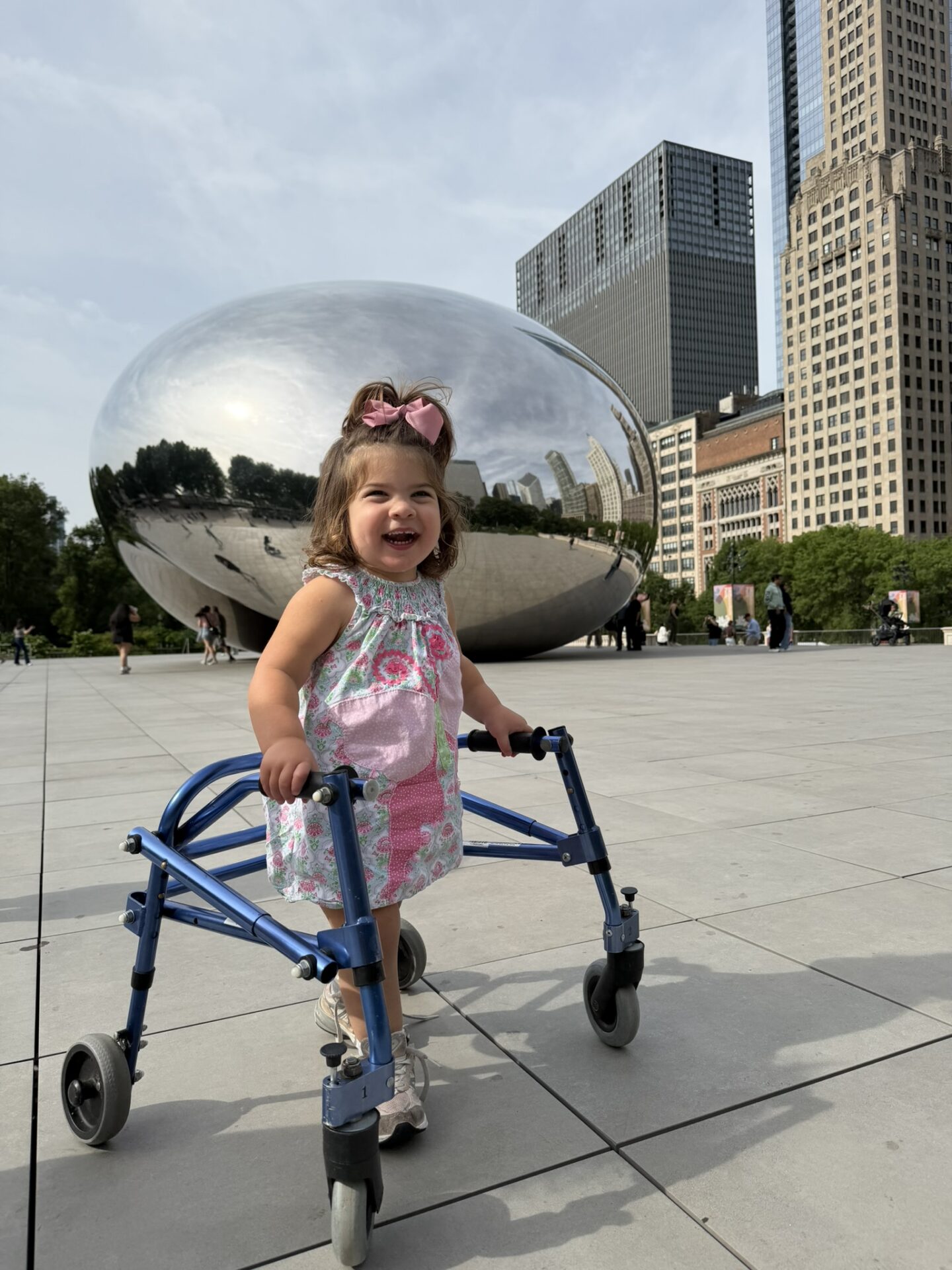
At 27 months, Olivia has taken her first independent steps. More importantly, she is now engaging in play with her siblings in ways she was unable to before. She is chasing, exploring her environment, and participating in functional activities that naturally drive motor learning across multiple domains.

For Practitioners

When evaluating a young child with hypotonia who is avoiding or unable to sustain weight-bearing activity, consider whether external support might unlock the motor practice necessary for progression. The evidence is clear: children fitted with SMOs do not slow down developmentally; they accelerate. Olivia’s case is not exceptional. It is representative of what should be expected when we provide the right tool at the right time.

The SMO3D, combined with appropriate postural support tools, creates an environment where a child can sustainably practice being vertical. Over time, as the child’s strength increases, the demand on the device decreases naturally. This is orthotic management working as intended: scaffolding motor development, not replacing it.
Learn More About SMO3D

Interested in bringing SMO3D to your patients? Sign up for our introductory course to get started.

register
From Crawling to Cruising: How Surestep’s SMO3D Supported Olivia's Journey

From Crawling to Cruising: How Surestep’s SMO3D Supported Olivia’s Journey 

When Olivia was diagnosed with severe global developmental delay and hypotonia at 15 months, her family feared she might never walk or keep up with her siblings. Born at 33 weeks, Olivia’s early delays had kept her parents watchful from the start. At first, they chalked the slower pace up to her premature arrival. But by 15 months, something felt different. Her family sensed that Olivia was falling further behind than her adjusted age could explain, and they trusted that feeling. 

A neurology referral provided an answer: severe global developmental delay and hypotonia. Through genetic testing, they also discovered a variance of unknown significance in the SRRM2 gene. For Olivia and her family, this answer was the start to helping Olivia reach her milestones.

Building a Foundation

Olivia made progress in therapy, but movement remained a significant challenge. She was not yet cruising furniture or climbing. Crawling had become her comfort zone, and her mother, Anna, worried that walking might stay out of reach.

“She was getting so comfortable crawling,” Anna says. “I worried she would never get to practice walking.”

Olivia’s parents noted that one foot was more pronated than the other, with pronation being a common finding in children with low muscle tone. In combination with her gross motor delays including not walking yet, her healthcare team suggested ankle braces – specifically SMOs.

SMO stands for Supramalleolar Orthosis—a type of lightweight ankle brace that sits just above the ankle bones (the “malleoli”) and fits inside a shoe.

What Do SMOs Do?

SMOs help improve foot and ankle alignment. They provide gentle support to keep the heel and foot in a more stable and optimal position during standing and walking. Unlike taller braces, SMOs allow for more natural ankle movement while still offering targeted stability. This helps children build strength and coordination while moving more confidently and safely.

The decision to move forward with SMOs was one Anna approached with cautious optimism and a few understandable nerves. Would Olivia tolerate wearing them? Would the daily routine of getting them on and off become a source of stress for the whole family? These are questions many parents quietly carry into their first orthotics appointment.

“I was a little nervous and intimidated wondering if she was going to like them and about even the process of getting them on and off,” Anna says.

A Turning Point

Olivia started out with Surestep SMOs on both sides to provide her with dynamic movement, paired with a reverse walker that helped her stay upright while she practiced standing. These braces supported her feet and ankles while the walker took some of the work off her body as she built strength. It worked beautifully. Soon Olivia was pulling herself up on her own, figuring out how to steer the walker, and seeking out standing on her own. She kept building her balance and getting more comfortable staying upright.

As Olivia got bigger and stronger, she started working towards more advanced skills. She presented with gait asymmetry as the one leg rotated out more than the other. With goals of continued symmetry, energy efficiency, and play, her team suggested switching to the 3D printed Surestep SMO3D to keep her moving forward. This new brace gave her exactly what she needed at this stage: continued dynamic support that lets her keep exploring new movements without holding her back, a breathable design so she doesn’t overheat when she’s working hard, flexible structures over her malleoli for increased comfort, and bonus for parents: a narrower heel post that’s way easier to slip into shoes.

As Olivia spent more time upright and on the move, her strength improved. The asymmetry Anna had noticed in her gait began to resolve. With the SMOs, her body learned to work in a more supported, aligned position. Motor milestones that had once seemed distant started arriving, one after another. And at 27 months, Olivia has even taken a few steps on her own.

She Loves Being Vertical

The shift in mobility has had an impact that extends beyond the physical. When a child can move through the world more freely, engage with siblings, explore her environment, and participate in play in new ways, development has more room to happen across the board.

“It’s so fun to see Olivia chase her older siblings around and interact with them in ways she wasn’t able to before,” Anna says. “In addition to motor development, I feel her progress has helped with her other areas of development as well.”

For Parents Still on the Fence

Anna understands the hesitation. She felt it herself. The unknown of a new device, the worry about whether your child will accept it, the logistics of making it part of an already full daily routine. But looking at where Olivia is now compared to where she started, her perspective is clear.

“It’s a no brainer,” Anna says. “We want to give our kids the tools to help them succeed and live as normal a life as possible. SMOs are one of those tools.”

Explore Surestep

Every child’s journey looks different, but no parent should have to navigate it without the right tools. If you have questions about whether SMOs could support your child’s development, start the conversation with your pediatric orthotist or physical therapist. And if you are ready to find a Surestep provider, we are here to help you get there.

Find a Provider

To find a provider near you who offers Sprout3D, please complete the form below.

find a provider
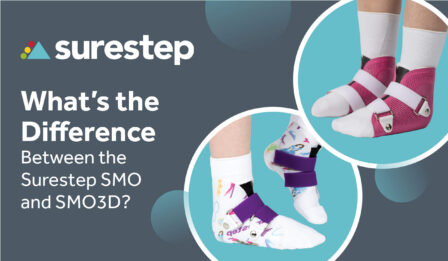
What’s the Difference Between the Surestep SMO and SMO3D?

What’s the Difference Between the Surestep SMO and SMO3D?

The original Surestep SMO has been a clinically trusted solution for children with hypotonia for more than 25 years, built on a compression-based design that stabilizes the foot and ankle while supporting natural development. The new SMO3D expands on that foundation, reimagined through modern 3D printing technology. Both share the same clinical approach and are designed to deliver the outcomes clinicians rely on. So, which one is right for your patient?

Key Differences at a Glance

Standard Surestep SMOSMO3D
Fabrication MethodTraditional thermoplastic3D printed
Weight LimitUp to 90 lbs. (model-dependent)< 50 lbs.
Fabrication Time4-8 business days + shipping5 business days + shipping
Rush OrderingAvailableNot available
Designs / ModificationsMultiple models & modificationsNone currently—expanded design choices coming soon!
AdjustabilityHighly adjustableMinor adjustments only
Heel PostThermoplastic heel postNarrower heel post allows for easier shoe fit
BreathabilityNo perforationsPerforated throughout for added comfort
Malleoli ComfortCut-outs available in the Big Shot modelsAuxetic structures contour around the malleoi
CosmesisFun transfer patterns available5 vibrant solid colors
Footplate Trim LinesStandard trim lines or modifications availableStandard trim lines only
Straps, PadsSameSame

The thermoplastic Surestep SMO under our Dynamic Stability line includes several modifications, giving clinicians flexibility for a wide range of patient needs:

  • Open Heel: Features the Surestep SMO with an open heel modification. This design facilitates posterior weight shifts to encourage improvements in squatting, development of a heel-toe gait, and increased sensory input.
  • Big Shot: The perfect SMO solution for older children or children over 80 lbs. who still need stability.
  • Toe Walking: SMO modification designed for patients with low tone who toe walk due to sensory or stability concerns.
  • Reverse Trim Lines: Foot trim lines to address metatarsus adductus or excessive supination
  • Clubfoot Modifications: Abducts the forefoot 5-7 degrees and utilizes reverse trim lines

We also introduced the Max Control SMO under our Alignment Control line that offers more rigid control of the foot and ankle, featuring a full footplate to improve foot and ankle alignment and stability for confident movement.

Having both a thermoplastic and a 3D-printed option means you can match the device to the patient, not the other way around. The SMO3D tends to be a strong fit for lighter patients (≤50 lbs) where shoe fit, breathability, or wear compliance is a priority. The narrower heel post and low-profile silhouette make it easier to fit into most footwear, and the perforated design helps with heat regulation. If your patient needs more significant customization, weighs more than 50 lbs, or you need a rush order, the thermoplastic Surestep SMO may be the better option. As always, the right choice depends on your clinical judgment and the individual needs of your patient. These guidelines are simply a starting point. 

Frequently Asked Questions (FAQs)

Q: What is the turnaround time for SMO3D? 

Five days plus shipping. 

Q: Is rush fabrication available for SMO3D? 

No, if you need a rush order, we recommend utilizing the standard Surestep SMO.  

Q: How can I submit my order? 

Orders can be submitted through our online ordering portal or by emailing an order form to [email protected]. Our team can fabricate based on measurements, scan, or cast.  

Q: Is it easy to heat adjust or change the strap/chafe location? 

The SMO3D Modification Guide provides more information on available modifications. If you need to change the chafe location, contact customer service at 877.462.0711. 

Q: Can the perforated area be trimmed back? 

Please do not trim the perforated area, as it will compromise the integrity of the device.  

Q: How much does SMO3D cost? 

For more information on pricing, please contact our customer service team.  

Q: What are auxetic structures? 

Auxetic material structures widen when stretched and narrow when compressed. In the SMO3D, these structures allow the SMO to flex and expand around the malleoli for added comfort and freedom of movement.  

Q: What kind of customizations are available? 

Currently, the SMO3D is a more standardized device due to the manufacturing process. If customization is required beyond what we offer in the ordering portal, we recommend exploring thermoplastic options like the Surestep SMO. 

Learn More

Want a deeper dive? Join Surestep’s live webinar, Printing Potential: Advancing Gross Motor Skills with the Surestep SMO3D (1.25 CEUs), covering case studies, ordering, fitting, and family education.

register

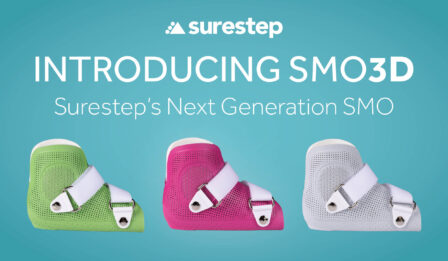
Introducing SMO3D: Surestep’s Next Generation SMO

Introducing SMO3D: Surestep’s Next Generation SMO

More than 25 years ago, Surestep redefined how clinicians support children with hypotonia by introducing a compression-based SMO that set a new standard of care. Built on a deep understanding of real-world clinical needs, the Surestep SMO became a trusted solution for children with hypotonia and pronation. Using extremely thin, flexible thermoplastic, the Surestep SMO’s innovative design compresses the foot’s soft tissues, stabilizing children while still allowing for natural development.

The Surestep SMO3D builds on that clinically trusted foundation, now re-imagined through modern 3D printing. Lightweight and flexible, this next-generation design provides the support needed to improve balance and coordination without restricting movement. Purposefully engineered to meet the needs of patients and practitioners, the SMO3D brings proven Surestep principles into a new era of orthotic care. 

Innovative 3D-Printed Design  

Advanced 3D printing enables precise fabrication and functional design features, including auxetic structures that flex and expand around the malleoli for added comfort, variable wall thickness for targeted support, and durable color-dyed materials that maintain their vibrancy.  

Comfort that Encourages Wear

Lightweight, flexible materials and a perforated design offer breathability and freedom of movement. The low-profile silhouette and narrower heel post allow the SMO3D to fit into shoes more easily, supporting more consistent wear.   

Clinically Trusted Results

Rooted in the same compression-based approach used in the fabrication of nearly 2 million SMOs worldwide, the SMO3D is designed to deliver results clinicians can rely on.

 SMO3D Features & Benefits

  • Flexible: Auxetic structures built over the malleoli provide added flexibility over bony prominences 
  • Shoe-friendly: Thin, smooth surface and narrow heel post allow the device to fit easily into most shoes 
  • Targeted support: Custom wall thickness throughout the device provides stability without added bulk 
  • Durable color: Dyed color that lasts through the duration of treatment 
  • Lightweight: Designed to be a lightweight solution to improve patient comfort and compliance 
  • Breathable: Perforated design throughout allows for a cooler, more comfortable fit 
  • Reinforced rivet holes: Solid, non-perforated material around the rivet hole provides added strength and long-term durability

SMO3D Specs

  • 3D Printed from PA12 Nylon Filament 
  • Fabricated based on measurements, cast, or scan 
  • Weight limit ≤ 50 lbs 
  • Support Level: Dynamic Stability 
  • Color Options: Light Gray, Dark Gray, Green, Teal, Pink 

Join a Live Webinar (1.25 CEUs)

Ready to dive deeper? We invite you to join us for a live webinar session, Printing Potential: Advancing Gross Motor Skills with the Surestep SMO3D. This one-hour course will present case studies of pre-ambulatory and early ambulatory children, including their progress with the Surestep SMO3D. Additionally, we will cover best practices for ordering, fitting, and educating families and healthcare teams. 

Become a Surestep Provider

Interested in bringing SMO3D to your patients? Sign up for our introductory course to get started.

register